
By Kayode Adebiyi
President Bola Tinubu recently ordered the withdrawal of police personnel from protecting very important persons (VIPs) to free up more operatives for deployment amid a spike in insecurity across the country.
The order, along with declaring a state of emergency on security, is part of measures marking a significant attempt to reallocate scarce law enforcement resources back to core public policing duties.
The president also mandated the police to recruit more personnel, to the tune of 50,000, to deliver more efficient police services in security-challenged areas of the country.
Analysts say Tinubu’s move, which has seen thousands of officers recalled, has created an immediate security void for the elite, thereby posing a critical question.
The question is: Can Nigeria’s growing private security industry effectively take over the mantle of VIP protection?
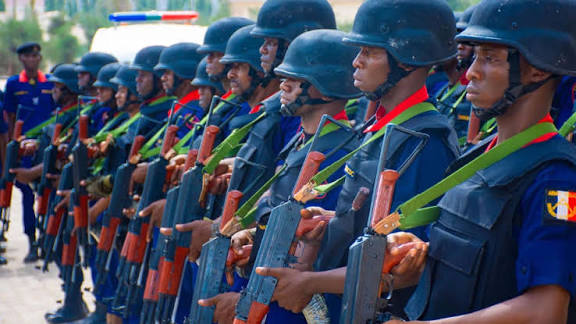
Initially, the president’s Special Adviser on Information and Strategy, Bayo Onanuga, said that, going forward, VIPs requiring protection would be assigned armed operatives from the Nigeria Security and Civil Defence Corps (NSCDC).
“In view of the current security challenges facing the country, Tinubu is desirous of boosting police presence in all communities,” Onanuga said.
However, a former Director of the Department of State Services (DSS), Mike Ejiofor, argued that the NSCDC lacked the capacity to take over such a responsibility.
In an interview on national TV, Ejiofor said, “The NSCDC does not have the capacity; they are not trained for it.
“They do not have the numbers to deploy, and their statutory function is to provide security for critical infrastructure.
“That means you would also have to train them for VIP protection; so it is a very dicey situation.”
Some analysts say the presidential order aims to address the long-standing problem of misallocated manpower.
They cited several cases in which a substantial portion of the nation’s police force was deployed to serve politicians, business executives, and celebrities.
Some reports estimate the figure to be as high as one-third of the police’s strength.
For years, this practice has been widely criticised for draining manpower from communities battling high crime rates, banditry, kidnapping, and terrorism.
In light of this, the president’s directive is generally viewed as a courageous step with the political will necessary to succeed, unlike previous failed attempts initiated by former police chiefs.
Therefore, judging by stakeholders such as Ejiofor’s take that the NSCDC lacks the capacity to step in, the private security sector is poised for an inevitable surge in demand.
Experts say the private security industry in Nigeria, which already comprises more than 3,000 licensed companies regulated by the NSCDC, is positioning itself as the immediate solution.
Mr Okechukwu Nwanguma, Executive Director of the Rule of Law and Accountability Advocacy Centre (RULAAC), said that the growth of the private protection industry was both “natural and even desirable”, provided the sector was appropriately regulated.
He said that private protection for the wealthy was a standard practice globally, not the responsibility of publicly funded police.
A security expert who simply identified himself as Ikule said that the industry was well-positioned to absorb the increased demand, highlighting that private companies already secure critical infrastructure like banks.
Maj.-Gen. Elvis Njoku (retired), Chairman of the Association of Licensed Private Security Practitioners of Nigeria, also confirmed that the industry was ready to fill the operational gap.
He said that the sector had “come of age”. According to him, applications for new security arrangements are already being submitted to the NSCDC.
However, other analysts and security experts are urging cautious enthusiasm, saying any transition to private security for VIPs is troubled with challenges, primarily centered on capacity, regulation, and the law on arms carriage.
The most critical constraint, they pointed out, is that private security guards in Nigeria are not permitted to carry firearms under current laws.
This contrasts sharply with the armed protection previously provided by police officers and the high-risk environment VIPs operate in.
Njoku, of the security practitioners’ association, acknowledged the legal barrier.
He said that the association was not pushing for an immediate change, given the proliferation of small arms in the country.
This limits private guards to a purely defensive, unarmed role, a key distinction from state-provided armed escorts.
Security experts have also consistently urged the government to strengthen laws governing private guard companies and ensure strict oversight to prevent abuse or unprofessional conduct.
A 2022 survey on private security challenges highlighted issues such as illiteracy among guards, poor equipment, low wages, and inadequate training, which must be addressed rapidly if the industry is to handle high-stakes VIP protection.
There is also the significant concern that the lucrative, informal economy built around police VIP attachments, which experts estimate at up to N108 billion annually, could simply re-emerge in new, opaque forms.
Security analysts warn that without robust transparency and strict enforcement, the incentives driving illegal deployment may persist, with senior officers or brokers potentially profiting through informal subcontracting or the use of off-duty police.
“The fact that the police had to deploy a Special Enforcement Team to ensure full compliance with the directive tells you that there is an incentive driving it,” an analyst said.
There is an acknowledgment that Tinubu’s order is a pivotal moment intended to redefine Nigeria’s security architecture.
While the withdrawal of police from VIP duties is largely seen as a necessary and commendable step towards strengthening community policing, stakeholders say its success depends heavily on rigorous enforcement.
They also say that the rapid, qualitative scaling up of the private security industry is crucial to that success.
They say, for the private sector to truly take over, an urgent and comprehensive review of the 38-year-old Private Guard Companies Act is required to professionalise the sector, standardise training, and integrate them effectively.
There have been calls for a review of the directive, including by lawmakers, for it to exempt politically and legally exposed key figures like justices and policymakers.
However, the true measure of success will not be the protection of the few, but the enhanced safety of the majority.
Ultimately, stakeholders say, going by the latest presidential directive, it has become imperative to review the extant legal mechanism regarding licensing of military grade rifles so that private, well-trained security guards can effectively fill the gap in VIP protection.
.Adebiyi writes for the News Agency of Nigeria