
Dare Babalola
The Action Democratic Party (ADP) criticised President Tinubu’s 2026 budget on Tuesday, citing rising debt, poor budget implementation, and insecurity as threats to Nigeria’s economic stability.
ADP National Chairman Yabagi Sani stated in Abuja that Nigeria’s facing a “crisis of fiscal credibility”, with budgets prioritising numbers over implementation and results.
Sani noted that public debt had climbed beyond ₦100trn, with debt servicing now consuming a disproportionate share of federal revenue at the expense of social and capital spending.
He noted that uncertainty around the 2026 budget’s key assumptions – oil output, exchange rates, and deficit financing – is already shaking investor confidence and business plans.
He said, “Nigeria now faces a crisis of fiscal credibility—not only in the size of budgets, but in execution, clarity, and confidence. As the nation approaches 2026, public debate has intensified around overlapping fiscal cycles and persistent extensions.
“While headline figures dominate discussion, execution remains the deeper problem. By late 2025, less than 20 per cent of the 2025 capital budget had been released, leaving critical infrastructure stalled.
“Public debt has crossed ₦100trn, with debt servicing consuming over 60% of federal revenue, crowding out social and capital spending. Uncertainty surrounding the 2026 budget—assumptions on oil output, exchange rates, and deficit financing—creates economic risk by undermining investor and business planning.”
The ADP chairman added that by late 2025, less than 20 per cent of the 2025 capital budget had been released, while debt servicing was crowding out development spending.
He also highlighted the country’s power sector as a symbol of budgetary failure, noting that Nigeria still generated under 5,000 megawatts of electricity for a population of over 220 million, forcing businesses to rely heavily on generators at huge cost.
Sani warned, “An economy cannot industrialise in darkness. Budgeting without execution is not reform. Borrowing without assets is not development.”
On the broader impact of recent economic reforms, the ADP chairman acknowledged that policies such as fuel subsidy removal and foreign exchange unification were presented as necessary, but said the absence of effective social protection had translated into widespread hardship.
He said national household surveys showed that more than 60 per cent of families had experienced a decline in real income since 2023, while inflation and currency depreciation had eroded savings and purchasing power.
Sani stated, “Economic reform must not become economic punishment. A responsible government reforms and protects.”
The ADP’s remarks echoed wider concerns that Nigeria’s annual budgets, though expanding in size, have yet to deliver commensurate improvements in welfare, productivity and social stability.
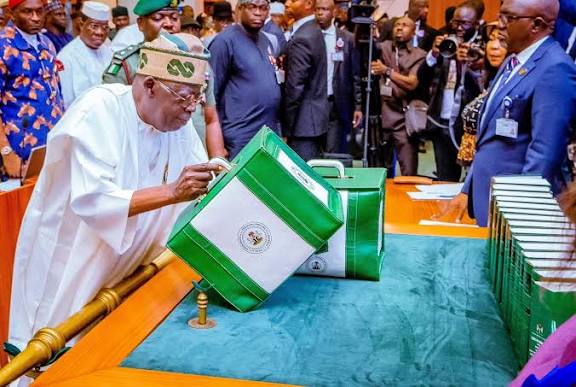
Last Friday, the President presented the 2026 Appropriation Bill to the National Assembly, projecting a cautiously improving economy while pledging stricter budget discipline and tougher revenue enforcement across government agencies.
The president also vowed to adopt an uncompromising security posture, declaring that all armed non-state actors would be treated as terrorists under his administration’s security doctrine.
Presenting the proposal—titled “Budget of Consolidation, Renewed Resilience and Shared Prosperity”, Tinubu said the fiscal framework was designed to lock in recent macroeconomic gains, restore investor confidence and translate stability into broad-based prosperity.
He defended the administration’s controversial economic reforms, arguing they were beginning to yield results.