Dare Babalola
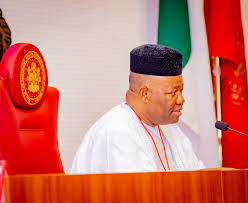
Senate President Godswill Akpabio has emphasised that the National Assembly will not be held hostage by individual members’ disruptive tendencies, stressing the need for discipline and adherence to rules to maintain the sanctity of Nigeria’s democracy and uphold the upper chamber’s dignity.
The Senate President, spoke in a statement signed by his media aide, Eseme Eyiboh, on Saturday.
The statement was titled “The Trials and Triumphs of a Resilient Nigeria’s 10th Senate.”
He emphasised that the legislatures’ commitment to enforcing its rules isn’t about stifling dissent, but rather about maintaining order and upholding the integrity of democratic institutions, thereby ensuring the stability and effectiveness of the democratic process.
Akpabio said, “The Senate cannot and will not be held hostage by the disruptive instincts of any of its members.
“Democracy thrives only when its institutions are respected and its rules upheld.”
Although Senator Godswill Akpabio didn’t name any lawmaker, his remarks come against the backdrop of heightened tension in the Senate, particularly surrounding Senator Natasha Akpoti-Uduagha’s recent return from a six-month suspension, which she continues to contest, fueling fresh controversy and power play within the upper chamber.
The Senate President emphasised that maintaining discipline in parliamentary proceedings is a hallmark of advanced democracies, citing examples from countries like the United Kingdom, Canada, and Australia, where legislatures uphold high standards of conduct, and stressed that the Nigerian Senate is committed to upholding similar principles of discipline and decorum.
Akpabio continued, “The discipline of parliamentary conduct is a universal marker of political civilisation.
“In the United Kingdom’s House of Commons, the authority of the Speaker is absolute and unchallenged. No member, regardless of party or popularity, may openly defy the Speaker’s ruling without consequences.”
He argued that the Senate’s rules were not outdated or symbolic, but an essential part of governance designed to protect fairness, stability, and respect for leadership.
“The Nigerian Senate’s Standing Orders are not ceremonial relics from the past.
“They are the living constitution of the institution, carefully designed to preserve fairness, consistency, and the sanctity of the legislative process,” he noted.
Akpabio further defended the right of the legislature to discipline its members when necessary, drawing parallels with other democracies where lawmakers face suspension or expulsion for violating parliamentary order.
“In the world’s most respected parliaments, members who flout rules face swift consequences. In the British House of Commons, suspension or expulsion is not rare when a member’s behaviour undermines parliamentary dignity. Nigeria’s Senate has every right to apply similar standards,” he noted.
The Senate President described the 10th Senate as “a chamber of resilience and balance,” adding that its leadership was determined to demonstrate that “freedom within order is the truest form of democracy.”
“When the chamber asserts that it will not be held hostage by the disruptive instincts of any single member, it is affirming the primacy of collective responsibility over individual grandstanding.
“This is how strong legislatures endure — not by silencing dissent, but by ensuring that dissent respects the bounds of procedure,” Akpabio said.
The former governor also emphasised that his leadership approach was one of firmness and inclusion, saying the upper chamber must remain a stabilising force in the face of rising populism and public cynicism.
Akpabio said, “Leadership of this sort does not seek applause; it seeks stability. By upholding its Standing Orders, the Senate has reclaimed its moral authority and demonstrated that rules, properly enforced, are not instruments of oppression but shields against institutional decay.”
Akpabio’s statement comes amid renewed debate about legislative discipline and the limits of free expression within parliamentary settings.