Dare Babalola
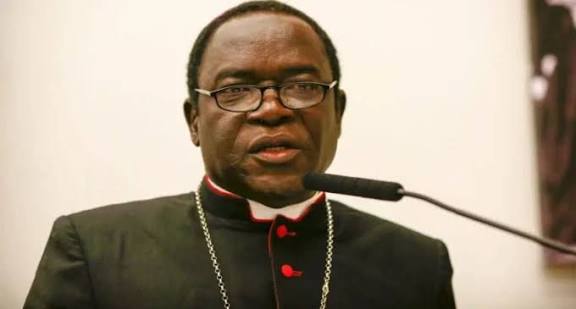
Most Rev. Matthew Hassan Kukah, Bishop of the Catholic Diocese of Sokoto and Founder, The Kukah Centre, has championed the survival of democracy in Africa, urging the continent’s leaders to prioritise equity and justice.
Delivering a keynote address at the Accra International Conference Centre during the week, Kukah said that despite the flaws of democracy in Africa, it remains the best option, noting that the continent has had its share of military rule.
The conference, themed, “Why Democracies Die” took an interesting turn when the keynote speaker, Kukah, suggested a more hopeful approach, exploring “How Democracies Survive”.
He emphasised that Africa’s democratic journey is complex, influenced by military rule, colonialism, and neocolonialism.
Kukah believes strong institutions, free media, and civil society are crucial for democracy’s survival, stressing that politicians must prioritise service over personal gain and learn to manage conflicts within and outside their parties.
The conference highlighted the need for a nuanced understanding of democracy’s challenges and opportunities.
He said, “African scholars must find reasons to focus on Africa’s historical and cultural histories, appreciating that even after over two hundred years of exploiting others, democracy is still a work in progress everywhere. We must look inwards for our own flaws that could make our own democracy vulnerable.”
Kukah continued, “In the course of assessing our progress with democracy, we cannot ignore the savagery, brutality, and bloodshed that are now woven into the fabric of our legacies as countries and a continent as part of our past. Nor can we ignore the extent to which military rule arrested our march to democracy on the continent.
“Propelled by false narratives of a missionary zeal to drive progress, the military marched into state houses across the continent claiming that they had come to redeem their people. However, years of military brutality and bloodshed through endless coups and countercoups across Africa fractured the democratic ecosystem, destroying the foundations of our culture of human rights, free media, a functional and effective Bureaucracy, Judiciary, Constitutions and Legislative Assemblies etc. Years of misrule resurrected and deepened ethnic consciousness as ethnic blocks sought to use the military to institutionalise their hegemony.
“Subsequently, in the 90s, after the so-called, end of history, half-hearted plans to return our countries to the path of Democracy were often marred by the blind ambitions of military autocratic dictators mutating into false democrats. In my view, debates about the quality of our democracy must be measured against the backdrop of this convoluted history.”
Despite challenges, Kukah remains optimistic about democracy’s prospects, citing humanity’s quest for justice, love, fairness, and community as driving forces.
The bishop said, “With all its structural flaws, Africa’s march to democracy is seemingly unstoppable. Africans know where they have come from, the future may be uncertain, but they have no hope of returning to the Egypt of autocracy and dictatorship that has been their lot since independence. Our two countries, Nigeria and Ghana remain the best examples of this malfeasance.
“Today, our people are hungry, they are still poverty-stricken and are living in destitution. Yes, democracy has not delivered what it promised to them. Yes, democracy has not made them safe. Yes, democracy has not ended years of oppressive and suffocating corruption. Yes, our people are still caught in the cusp of violence. Yes, democracy has not educated them, it has still left them sick. Yet today, our people have nailed their hopes for progress and development on the mast of democracy despite these very strong headwinds.”
“Our people have now realised that military rule has proved itself to be a cure worse than the disease and the military itself has realised how much damage its adventure into politics has done to it. The Sahelian coups may have created a false sense of appeal, but despite the plastic and manufactured populism and adulation, I do not see how long they can last. Therefore, the challenge is for Africans of this generation to ensure that in our hands, these seeds of democracy are watered and nurtured,” he added.
Kukah continued, “Going forward, I believe that this discussion is timely and quite auspicious. However, your topic, ‘How Democracies Die’ should be replaced by a more hopeful title, ‘How Democracies Survive’. Our concerns should be on how to learn lessons about the consequences of democracy dying here or elsewhere and seeking how to avoid that from happening. A good driver, seeing another car in the ditch after an accident would do well to ensure that he or she avoids the same fate by obeying the rules. There is a saying in Hausa which translates as; If you see your brother’s beard on fire, put water on yours immediately. Africans must learn that Democracy is hard work with no easy answers. Democracy is a labour of love, a hope, a dream and vision that one generation must pass to the next. Our challenge is that each generation should make the job easier for the next.”
Kukah added that the causes of the deaths must be studied saying, “If we are concerned about How Democracies Die, then, like all deaths, we must accept that the causes will not be same. Therefore, when we speak of the manifestation of democracy’s failure through; institutional fragility, shrinking spaces, the weakening and dismantling and weakening of democratic systems, we must ask if they are causes or consequences of the death of democracy.
“In other words, are we perhaps confusing the symptoms with the disease? Diseases do not necessarily kill everyone who contracts them.. Some people have better immune systems than others. Therefore, assuming we speak of the possibility of the death of Democracy, what does it take for a Democracy to survive or die in one place and not the other?. For example, during the period of COVID-19, the reports said that most of those who died already had certain prevailing health conditions that weakened their immune systems. Similarly, the quality of democracy will be measured by the presence or absence of certain conditions.”
He noted that the rise of different terrorist groups poses a threat to democracy but maintained that rather than talk about its death, it is better to discuss the challenges.
He said, “Although all of these pose severe threats to democracy, I would rather that we speak of the challenge to democracy rather than its death. In my view, as long as human beings exist, there will be democracy. If we see democracy from the point of its leaders, office holders, institutions, parliaments, and political associations or parties, then, we might contemplate its death when these human beings die.
“However, when we see democracy as part of the human instinct, our thirst and hunger for justice, love, fairness, integrity, sense of belonging, community and family, then democracy cannot die. To be sure, politicians, political parties, parliaments, and constitutions can be banned or destroyed as we have seen by autocrats in and out of uniforms, but the human instincts and quest cannot die. We can therefore argue that certain types of structures for the pursuit of human happiness, security and wellbeing could collapse in the hands of wicked men, but others will spring up. Democracies might differ in form, just as food, arts, music, social habits etc. differ among different peoples and countries.”
“The problem of many African countries today is that they never really experienced successful transitions. After colonial rule, most countries gained independence and then began what they considered to be a journey toward democracy. Sadly, these journeys were interrupted by military coups and hamstrung by neocolonial structures that made it almost impossible for them to function effectively. We went through rudimentary elections but never developed a political culture. Therefore, many African nations transited from colonialism, military dictatorships, but did not successfully transit to democracy. This is because the military often sowed too many landmines whenever they attempted to set up so called, transition to civil rule programmes.
“Western liberal democracy which we have adopted across Africa focuses on free markets, a capitalist economy focusing on transparency, accountability, a free media, human rights, a free judiciary, rule of law fighting corruption. The elevation of these concepts does not address other fundamental cultural factors that blur the lines in African cultural discourse. Anticorruption weighting agencies side step corporate corruption and focus on their manifestations in African politics. Illegal financial flows continue to undermine democracy and its capacity to deliver on social goods, yet, western governmenets and banks are not prepared to help Africa address these issues. Weighting agencies have offered us a broad range of indices for measuring democracy and its effectivenes. The Mo Ibrahim Index for example broadly measures the efficacy of democracy by looking at where countries stand in regards to; freedom, political participation, media freedom, education, human rights, security, transparency & accountability, anti-corruption, sustainable development etc.
“There is no doubt that democracy is imperiled today, but it is not dead. Let us not become victims of exaggerated pessimism. What is going on in the United States of America today is a lesson. After over two hundred years, the behaviour of Donald Trump and his supporters on June 6th, 2022 suggests that time and experience are not enough to tame the human instincts to violence. It is however, a measure of the strength, resilience and rigidity of democracy’s guardrails that it was able to withstand the assault during those moments of madness. The point here therefore is that no matter how long democracy has been in a country, it is the strength of its institutions that sustains the occasional assault to its foundation. Democracy’s womb possesses seeds of the good, the bad and the ugly. Politicians must learn to manage their conflicts within and without. As a priest, I have had experience of helping to resolve marriage problems. In the end, with patience, families often find that if they communicate with patience, relationships become stronger when they each realise their mistakes. We often take those who love for granted.”
He concluded saying, “I wish to conclude by arguing that to the contrary, the notion of democracy dying is an oxymoron, we should rather focus on addressing the usage of various models of democracy that respond to the burning issues of human development.
“Therefore, I believe that like the air we breathe, the weather, the water and so on, democracy, is subject to toxicity, decay, rut, fracture but not death. Democracy will never die. There will be bad elections, but they can only be cured by drawing lessons and testing the limits of the claims of our constitution and electoral laws.”