
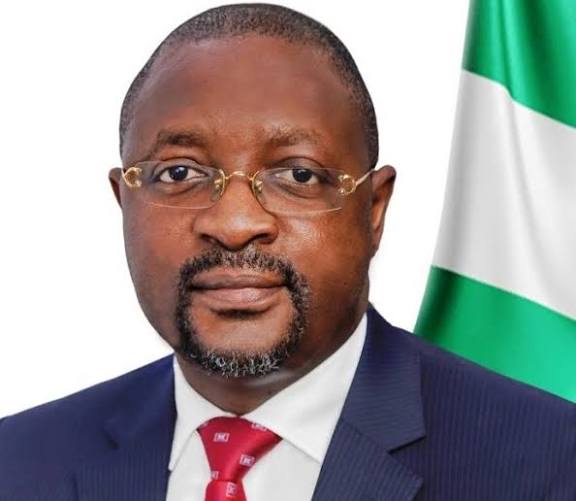
Dare Babalola
The Special Adviser to President Bola Tinubu on Media and Public Communication, Sunday Dare, has criticised economist and public affairs commentator, Professor Pat Utomi, over his recent remarks describing the Federal Government’s economic reforms as “ridiculous,” “poorly structured,” and a “Ponzi scheme.”
In a Facebook post on Wednesday, Dare accused Utomi of consistently engaging in what he described as “alarmist commentary” devoid of rigorous analysis, while arguing that the professor’s interventions in national discourse have repeatedly “collapsed under scrutiny.”
He wrote, “Professor Pat Utomi has once again chosen to dance naked in the public square, playing to the gallery with a familiar cocktail of grandstanding and gloom. This time, he has come to dismiss the reform programme of President Bola Ahmed Tinubu as ‘ridiculous,’ ‘poorly structured,’ and, in a flourish of intellectual overreach, a ‘Ponzi scheme.’”
Dare further questioned Utomi’s credibility in economic discourse, stating that his repeated interventions have not translated into measurable national impact.
“At this point, the issue is no longer what Utomi is saying. The issue is why his interventions consistently collapse under the weight of their own exaggeration, under the slightest scrutiny or interrogation,” he wrote.
He also referenced past corporate and policy experiences associated with Utomi, alleging that his public commentary contrasts sharply with outcomes from his engagements in the private and public sectors.
“Any reflective — indeed, discerning — mind would note that, after all these long years of sophistry and vacuous pontifications, all Utomi can possibly point to as his bonafides or bragging rights in the civic space today are the ruins of Volkswagen Automobile Ltd and BankPHB where his much touted ‘academic wizardry’ was exposed as ‘Ponzi scheme’,” Dare stated.
Defending the administration’s economic direction, Dare said the ongoing reforms are structural and evidence-based, insisting that they are already producing measurable fiscal outcomes.
According to him, key policy decisions such as fuel subsidy removal and exchange rate unification were necessary steps to correct long-standing distortions in the economy.
“Fuel subsidy removal (May 2023): eliminated a multi-trillion-naira fiscal drain, freeing up revenues for subnational allocations and deficit reduction,” he noted.
He added that exchange rate reforms had improved market transparency, saying, “Exchange rate unification collapsed multiple FX windows into a single market-reflective rate—an essential step flagged for years by the World Bank and International Monetary Fund.”
Dare further argued that increased Federation Account Allocation Committee (FAAC) disbursements and improved fiscal liquidity at the subnational level were early indicators of progress.
Dare accused Utomi and other public commentators of benefiting from what he described as a long-standing system that rewarded analysis without accountability.
“Nigeria’s economic distortions did not emerge in a vacuum. They were sustained over decades by a rotating class of commentators and advisers who theorized dysfunction instead of dismantling it,” he added.
He added that the ongoing reforms were dismantling entrenched structures that previously enabled arbitrage and inefficiencies in the system.
According to him, criticisms describing the reforms as a “Ponzi scheme” reflect a misunderstanding of macroeconomic realities.
“Calling a national reform programme a ‘Ponzi scheme’ is not provocative—it is intellectually hollow,” he stated.
Dare also pointed to what he described as improving macroeconomic indicators, including rising non-oil revenues, improved investor confidence, and early signs of stability in external reserves.
He highlighted ongoing reforms in taxation, customs modernisation, and digital revenue systems as evidence of a broader restructuring agenda.
“These are systems-level interventions—not soundbites,” he said.
While acknowledging that government policies remain open to scrutiny, Dare insisted that such criticism must be constructive and evidence-driven.
Dare continued, “Nigeria’s reforms are not beyond criticism. But they are on track and trackable. They demand scrutiny, refinement, and stronger social cushioning.”
He, however, maintained that Utomi’s latest intervention amounted to “rhetoric without rigor,” arguing that it adds little value to national economic debate.
“What Professor Utomi has offered is not scrutiny. It is not even rigorous dissent. It is amplification without depth… and in a moment that demands serious thinking, that kind of intervention is not just unhelpful—it is a distraction masquerading as insight,” Dare added.
Dare concluded by urging the professor to exercise restraint in his public commentary, stating that constructive counsel was welcome but “distraction is not.”