Dare Babalola
President Bola Ahmed Tinubu has announced plans by the Federal Government to deepen investments in modern policing systems, including enhanced training, intelligence gathering, and upgraded operational infrastructure.
The initiative forms part of ongoing reforms aimed at strengthening the Nigeria Police Force and improving its capacity to respond effectively to contemporary security challenges.
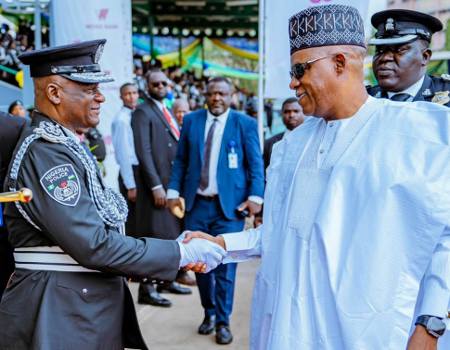
The President made the disclosure on Tuesday during the National Police Day Grand Parade and Procession held in Abuja, where he was represented by Vice President Kashim Shettima.
The event marks a formal recognition of the contributions and sacrifices of officers of the Nigeria Police Force.
According to a statement issued by Stanley Nkwocha, Senior Special Assistant to the President on Media and Communications (Office of the Vice President), the administration’s reform agenda is targeted at transforming the police institution into a modern, efficient, and globally competitive force.
President Tinubu stressed that sustainable national development cannot be achieved without a secure environment, noting that the government has a responsibility to continuously empower security institutions.
“The Nigerian state owes a permanent moral duty to empower its security agencies, as the nation’s peace is only as secure as the men and women who keep vigil over its citizens,” he stated.
He further emphasized that the administration would sustain investments in critical areas such as training, technology, intelligence-led policing, and improved welfare for personnel.
“We will continue to support these reforms through sustained investment in training and capacity development, modern equipment and technology, improved intelligence and investigative capabilities, and better welfare and working conditions for police personnel,” the President said.
Tinubu added that the objective of the reforms is to build a force capable of responding effectively to evolving security challenges across the country.
“We are determined to build a Police Force that is well equipped, well trained, and well-motivated to confront the complex security challenges of our time,” he stated.
Highlighting the often-unseen sacrifices of law enforcement officers, the President noted that while some professions receive widespread public recognition, others remain essential to the survival of society despite limited acknowledgment.
He acknowledged the critical role played by police officers, stating that the safety of any nation depends largely on those who maintain vigilance.
“Every nation is only as safe as those who keep vigil while others sleep,” he said.
President Tinubu also reiterated the importance of strengthening institutions responsible for national security, describing security as a foundational requirement for progress.
“Nigeria must strengthen those who protect the nation. Security is not simply the defence of territory or the prevention of crime. It is the first currency of progress,” he added.
The President noted that the observance of National Police Day, instituted in 2025, reflects the government’s commitment to recognizing the sacrifices of police personnel and reinforcing institutional reforms within the force.
Paying tribute to officers who lost their lives in the line of duty, Tinubu described their sacrifices as an enduring legacy that must not be forgotten.
“Their sacrifice is written into the conscience of our country. Their memory must remain a lamp to those who wear this uniform today and to those who will wear it tomorrow. To their families, I extend the profound gratitude of a grateful nation,” he said.
He also commended serving officers for their dedication in maintaining peace and order under challenging conditions, while urging them to uphold professionalism and respect for the rule of law.
“The uniform you wear is not a licence for arbitrariness; it is a covenant of service. The badge on your chest is not an ornament of power; it is a reminder of duty,” the President warned.
Tinubu further called for stronger collaboration between citizens and law enforcement agencies, emphasizing that trust remains central to effective policing.
“When citizens and law enforcement stand on opposite sides of suspicion, insecurity thrives. This is why community-centred policing is a democratic necessity,” he noted.
Reaffirming his administration’s vision, the President said the goal is to build a police institution defined by accountability, courage, professionalism, and public trust.
In his remarks, the Inspector General of Police, Olatunji Disu, acknowledged the expectations of Nigerians and pledged the commitment of the force to meet them.
He said the approval of National Police Day by the President represents a symbolic and practical recognition of both fallen heroes and serving officers.
The IGP called on personnel to uphold discipline and integrity, warning against misconduct that could undermine the image of the force.
He also assured Nigerians that under his leadership, the Nigeria Police Force would continue to evolve into a more professional, intelligence-driven, and accountable institution.
“The leadership of the force will stand firmly with every officer that follows the rules and serves with dignity, while assuring Nigerians of a more disciplined, accountable and professional police force,” he stated.
Disu added that ongoing reforms within the force are aimed at strengthening professionalism and embedding intelligence-led policing as a core operational strategy.
Goodwill messages were delivered by representatives of Wema Bank and Premium Trust Bank, who commended the police for their role in maintaining national security and pledged continued support for improved policing services.
The celebration featured a grand parade, procession, and tactical displays by various police units and cadets of the Police Academy.
Dignitaries in attendance included deputy governors from Nasarawa and Ebonyi States, representatives of the leadership of the National Assembly, service chiefs, former Inspectors General of Police, senior government officials, members of the diplomatic corps, and representatives of the Police Officers Wives Association (POWA).