
…demand tougher reforms
Dare Babalola
Three academics have thrown their weight behind the Federal Government’s decision to prohibit recipients of honorary doctorates from using the ‘Dr’ title, describing the move as necessary to protect the integrity of Nigeria’s academic system and curb the growing abuse of honorary awards.
The Minister of Education, Dr Tunji Alausa, announced the decision on Wednesday during a briefing at the Presidential Villa, Abuja, on the outcome of the Federal Executive Council meeting held on April 30.
He said the directive became necessary following widespread misuse and politicisation of honorary doctorate awards, which he said had eroded the credibility of such recognitions.
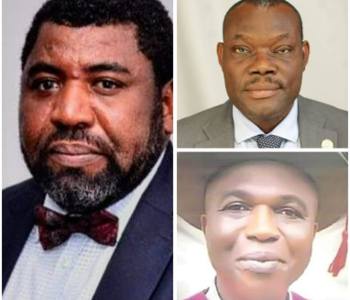
In separate interviews with Newstellers.ng on Wednesday, Prof Anthony Kila, Prof Wellington Oyibo and Prof Onyebuchi Ezeani praised the government’s action but urged broader reforms to restore standards in the education sector.
Kila: Ban right, but deeper reforms needed
Kila, Director at the Centre for International Advanced and Professional Studies, said he agreed with the minister’s position, noting that there must be a clear distinction between people who earned academic titles through rigorous study and those who received honorary recognitions.
“I think I agree with the minister on the need to protect the academic value of the title. It is important to differentiate between people who earned their title and those who were honoured with it,” Kila said.
He argued that while honorary awards should continue to recognise distinguished contributions in society, there should be another acceptable form of title that would not create confusion with earned doctoral qualifications.
“Where people have contributed to a certain field and they are given honorary doctorates because they deserve it, we should also find a way to recognise them. We need a new kind of title so that there is a clear difference,” he stated.
Kila, however, said the controversy goes beyond honorary awards, but reflects a wider crisis of standards and title obsession in Nigeria.
“The bigger issue is the standardisation of our world. There are organisations selling these awards in a very bad way. Some are non-academic, some even claim to be academic. You attend for one day, do one thing, and you are literally buying it,” he said.
According to him, the country must confront a dangerous culture where titles are valued above merit and competence.
“We seem to be very hungry about titles in Nigeria. If people are so keen on titles, why don’t they earn them?” he asked.
Kila added that the minister’s directive should be seen only as a starting point.
“The minister is singing along the right way. He has just done the first step. More needs to be done, and the conversation is not such a simplistic conversation,” he said.
Oyibo: It’s a moral and developmental issue
Oyibo, Consultant and Medical Parasitologist at the College of Medicine, University of Lagos, said the issue should be examined from moral, ethical and developmental perspectives.
He said the desire by some individuals to use titles they did not earn weakens institutions and sends the wrong signal to society.
Oyibo said, “We may want to ask the question: what is it about titles? Why do people want to bear what they never earned?
“The challenge with that is that it weakens the system. It shows a society where moral standards are weak. That is not good for the country because it can mislead people in many ways.”
He warned that misuse of titles could also create opportunities for fraud and deception, as some individuals might exploit honorary credentials to falsely legitimise themselves.
“There could be a lot of confusion around that. Some people may want to commit fraud or deception and begin to use such titles to legitimise who they are,” he said.
Oyibo commended the government for taking steps to address what he called a national moral concern, but stressed that regulation alone would not be enough.
According to him, Nigeria must also create more flexible academic pathways for experienced professionals and industry leaders who genuinely desire advanced qualifications.
“Let’s promote scholarship now. How do we make it easier for people to earn those titles?” he asked.
He cited examples of professionals with recognised certifications being allowed into postgraduate programmes abroad and said similar models could help Nigeria.
Oyibo added, “Flexible programmes should be developed for captains of industry and people with long experience. They can do bridging programmes, earn a master’s degree and proceed to PhD. They still have to go through the process, but the system can be more open.
“Development is a lifelong learning process.”
Ezeani: Doctorate title has been bastardised
For Ezeani of the Department of Political Science, University of Nigeria, Nsukka, the government’s decision is overdue because many people have abused honorary doctorate awards for years.
“So many people are abusing the award of honorary doctoral titles and parading themselves as if they passed through PhD programmes in universities,” Ezeani said.
He lamented that some people attend short seminars abroad, pay thousands of dollars, receive certificates and return home to style themselves as doctors.
“There are many people answering doctor, even in the university system, among non-academic staff, who didn’t do PhD. They went on a seminar in Dubai, and after the seminar they were given a title of doctor. Today they are answering doctor,” he said.
According to him, the practice has made it increasingly difficult to distinguish genuine scholars from title buyers.
“It becomes difficult to distinguish them from people who laboured for many years to do the doctoral programme,” he stated.
Ezeani also accused some universities of commercialising honorary awards by conferring them on politicians and wealthy individuals for financial gains.
“So many universities are abusing it, awarding it just to get money from politicians. Even people who don’t deserve it are being given honorary doctorates,” he alleged.
He urged the Federal Ministry of Education to issue strict national guidelines on who qualifies for honorary doctorates and how such honours should be conferred.
“It is a global phenomenon. World-class universities confer honorary doctorates, but not on everybody. You must have distinguished yourself in public service or academia to deserve that,” he said.
He concluded that the minister had taken the right step.
“There is a need for regulation, and I think the Minister of Education has done the right thing,” Ezeani added.
Calls for stronger oversight
The academics were unanimous that while honorary awards remain legitimate tools for recognising exceptional service, the process must be transparent, merit-based and free from commercialisation or political patronage.
They also agreed that protecting the value of earned academic titles would help restore public confidence in Nigeria’s education system and promote scholarship over ceremonial recognition.