
Dare Babalola
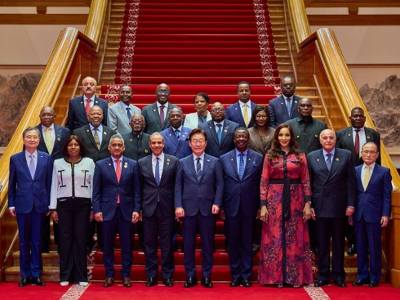
Nigeria has called for deeper international cooperation on climate change, security, health systems, and global governance reform during the inaugural Korea–Africa Foreign Ministers’ Meeting held in Seoul, South Korea.
Speaking at the high-level gathering, the Minister of Foreign Affairs, Bianca Odumegwu-Ojukwu, said the meeting—convened as a follow-up to the 2024 Korea–Africa Summit—brought together about 50 African foreign ministers to strengthen cooperation between Korea and the African continent.
She noted that shared global vulnerabilities require collective responsibility, stressing that challenges such as climate change, pandemics, and insecurity transcend national borders.
The minister said, “Climate change does not respect borders. Pandemics do not require visas. Conflict in one region disrupts supply chains in another.”
Odumegwu-Ojukwu highlighted Africa’s disproportionate exposure to climate-related disasters despite contributing less than four per cent of global carbon emissions. She cited environmental pressures such as the shrinking Lake Chad Basin, advancing desertification in the Sahel, and rising sea levels threatening coastal cities including Lagos and Dakar.
She proposed the creation of a Korea–Africa Green Energy Alliance to leverage South Korea’s technological expertise and Africa’s natural resources in advancing clean energy development across the continent.
On peace and security, the minister expressed concern over terrorism in the Sahel, piracy in the Gulf of Guinea, and unconstitutional changes of government in parts of Africa, noting their wider global implications. She, however, commended South Korea’s contributions to United Nations peacekeeping operations and called for stronger cooperation in intelligence sharing, maritime security, training, and support for African-led peace initiatives.
In the health sector, she underscored Africa’s heavy reliance on imports for essential medicines and vaccines.
“Africa still imports 99 per cent of its vaccines and 95 per cent of its medicines.”
She said Nigeria welcomes South Korea’s K-Bio initiative and proposed a Korea–Africa Health Security Compact aimed at developing regional vaccine manufacturing hubs across Africa through technology transfer and collaboration.
Odumegwu-Ojukwu also reiterated Nigeria’s call for reforms of global governance institutions, including the United Nations Security Council, the International Monetary Fund, and the World Bank, to ensure fairer African representation.
She expressed appreciation for South Korea’s support for Africa’s inclusion in global decision-making structures, while urging that such commitments be translated into concrete outcomes during forthcoming reform negotiations.
“Nigeria does not come to this meeting seeking charity but genuine partnership.”
She further described South Korea’s rapid economic transformation as an inspiration for African development aspirations.
During a separate engagement with selected African foreign ministers, South Korean President Lee Jae-myung reflected on his country’s post-colonial development journey and expressed willingness to deepen cooperation with African nations.
“The Republic of Korea, too, is a country that was liberated from colonial rule after World War II, and after going through difficult times, has come to where it is today. I think we walked a little faster from circumstances similar to those faced by your countries.
“I hope we can share that experience together and engage in in-depth discussions about what the Republic of Korea can do together with your countries and what support we can provide,” she stated.