
Ezekiel Awojide
The International Monetary Fund (IMF), on Tuesday reviewed Nigeria’s economic growth outlook upward.
The IMF cited stronger investor confidence, improved oil production, and a more stable macroeconomic environment.
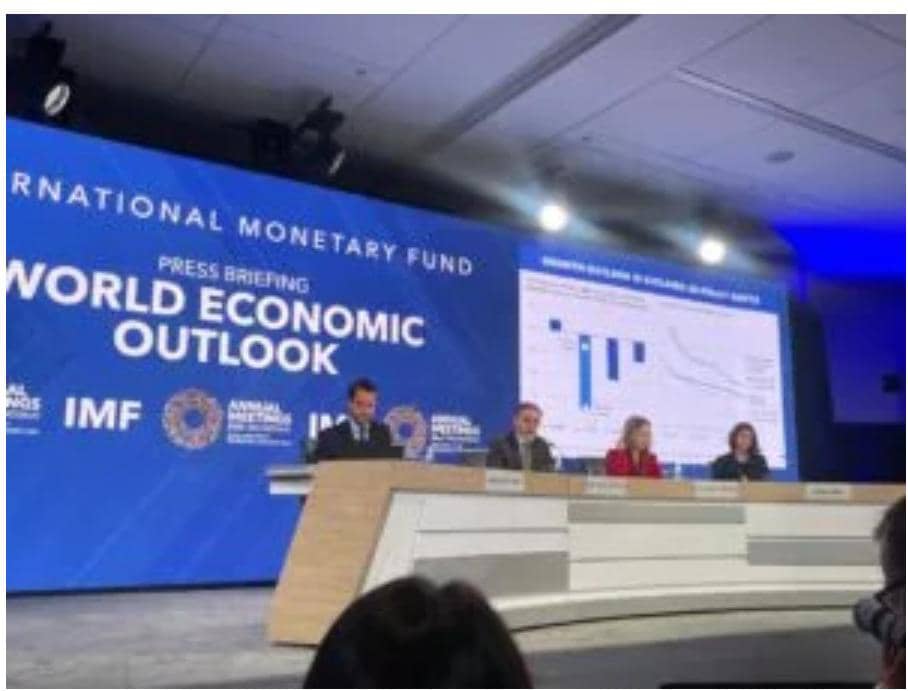
The Chief of the IMF Research Department, Deniz Igan, made this known at a news conference to unveil the Global Financial Stability Report in Washington on Tuesday.
She said that the fund projected Nigeria’s Gross Domestic Product (GDP) to grow by 3.9 per cent in 2025, an increase of 0.5 percentage points from its earlier forecast.
Igan said that the fund also upgraded the 2026 growth projection to 4.2 per cent, up by 0.9 percentage points, while the 2024 growth estimate had been adjusted to 4.1 per cent, 0.7 percentage points higher than previously estimated.
She said that the upward adjustment for 2024 reflected Nigeria’s recent GDP rebasing, which offers broader coverage of the economy, including previously underrepresented informal sector activities.
According to her, the 2025 and 2026 outlook reflects reduced uncertainty and the limited impact of U.S. tariffs on Nigeria, given its relatively low exposure to those markets.
Igan said that the IMF attributed a brighter outlook to several key factors, including the appreciation of the exchange rate since July, rising investor confidence, a supportive fiscal stance, and higher oil production amid improved security conditions.
“These developments have contributed to stronger hydrocarbon growth and overall economic resilience,” she said.
According to her, the revised projections signal renewed optimism for Africa’s largest economy as it continues to carry out reforms aimed at stabilising the macroeconomic environment, attracting investments, and diversifying its revenue base.
“For Sub-Saharan Africa, we have upgraded growth projections.
“Growth for 2025 has been revised up by 0.2 percentage points, and the same applies to 2026.
“We now project 4.1 per cent growth this year and 4.4 per cent next year,” Igan said.
She said that the resilience across the region had been supported by macroeconomic stabilisation measures and ongoing reform efforts in several key economies notably Ethiopia and Nigeria.
Igan, however, said that vulnerabilities remained.
“Resource-dependent and conflict-affected countries continue to face significant headwinds, and our medium-term outlook indicates that low-income economies in the region are still grappling with a widening per capita income gap compared to advanced economies.
“In such an environment, it is crucial for countries to strengthen institutions, deepen structural reforms, and mobilise domestic revenue through effective tax reforms.
“Additionally, improving debt management, transparency, and governance, alongside broader structural reforms, will be key to unlocking the region’s economic potential,” she said.