
Dare Babalola
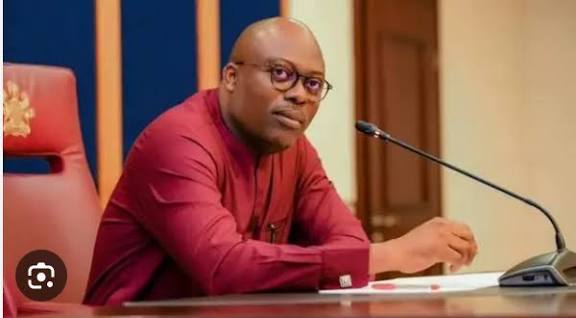
The political decline of Siminalayi Fubara from a governor who once commanded the machinery of Rivers State to a politician withdrawing from the All Progressives Congress governorship primary reflects one of the most dramatic power struggles in recent Nigerian politics.
What began as a succession arrangement engineered by former Rivers governor and current Minister of the Federal Capital Territory, Nyesom Wike, eventually degenerated into a prolonged political war that fractured the state’s political structure, paralysed governance institutions and weakened Fubara’s grip on power.
The Rise of Fubara
Fubara, a former Accountant-General of Rivers State, emerged as governor in 2023 largely through the political backing of Wike, who had dominated Rivers politics for nearly eight years.
At the time, Wike’s influence over the Peoples Democratic Party structure, state assembly and grassroots political network positioned Fubara as a successor expected to sustain the former governor’s political legacy after he joined President Bola Tinubu’s cabinet as FCT minister.
Fubara won the March 18, 2023 governorship election on the platform of the Peoples Democratic Party and was sworn in on May 29, 2023.
However, cracks soon appeared within months of his inauguration.
Fallout With Wike
The relationship between both men reportedly deteriorated over control of political appointments, state resources and the structure of government.
Sources within Rivers politics indicated that disagreements emerged over who controlled the political machinery of the state, including local government structures, appointments and influence over the state assembly.
By October 2023, the conflict had escalated openly.
Several commissioners believed to be loyal to Wike resigned from Fubara’s cabinet, exposing the deepening division within government.
Political observers noted that the battle was no longer merely about governance but about political supremacy between a sitting governor seeking independence and a predecessor determined to retain influence.
Rivers Assembly Crisis
The crisis reached a dangerous level in late October 2023 when the Rivers State House of Assembly became sharply divided.
More than 25 lawmakers loyal to Wike initiated moves widely interpreted as attempts to weaken or possibly impeach Fubara.
The political tension intensified after the Assembly complex in Port Harcourt was engulfed by fire on October 29, 2023, an incident that further heightened instability within the state.
Soon after, lawmakers loyal to Wike defected from the PDP to the APC, raising constitutional debates over the legitimacy of their seats.
Fubara’s camp argued that their defection automatically invalidated their membership of the assembly under constitutional provisions against defection, while the pro-Wike lawmakers insisted they remained legitimate members.
The governor subsequently worked with a smaller faction of lawmakers led by Edison Ehie, who emerged as a key ally during the height of the crisis.
The conflict created parallel claims to legislative authority and plunged Rivers into months of institutional uncertainty.
Federal Intervention and Failed Peace
As tensions escalated, President Tinubu intervened in December 2023 in an attempt to broker peace between both camps.
A peace deal reportedly required concessions from both sides, including the reinstatement of some political structures and recognition of certain interests linked to Wike’s camp.
Although both sides initially accepted the agreement publicly, the truce quickly collapsed as mistrust persisted.
The political crisis continued into 2024, with repeated disputes over local government administration, budget implementation and control of political institutions.
Analysts observed that while Fubara retained constitutional authority as governor, Wike continued to command significant loyalty among lawmakers, political appointees and party stakeholders.
The crisis later deepened when President Tinubu declared a state of emergency in Rivers State and announced the suspension of Governor Fubara, his deputy, Prof. Ngozi Odu, and members of the Rivers State House of Assembly following the prolonged political instability in the state.
Defections and Political Isolation
The prolonged conflict gradually weakened Fubara’s political base.
A growing number of politicians and stakeholders began aligning with Wike, who maintained strong influence both within Rivers politics and at the federal level through his role in the Tinubu administration.
The defections of lawmakers and political actors further isolated the governor.
The APC in Rivers also became increasingly central to the political calculations surrounding the crisis, especially as reconciliation efforts and possible realignments gained momentum ahead of the 2027 elections.
Insiders said several negotiations were held involving federal political figures, Rivers stakeholders and APC leaders in efforts to stabilise the state and prevent a deeper political breakdown.
APC Negotiations and Realignment
In one of the most surprising twists in Rivers politics, Fubara eventually moved closer to the APC political structure despite originally emerging through the PDP.
The shift was widely interpreted as part of broader reconciliation efforts involving Tinubu, Wike loyalists and APC stakeholders.
However, political analysts noted that Fubara entered the negotiations from a weakened position after months of sustained pressure and shrinking political leverage.
By 2026, attention turned to the APC governorship primary as the party prepared for the next electoral cycle in Rivers State.
But signs soon emerged that consensus arrangements and power-sharing negotiations were shaping the process behind the scenes.
Final Withdrawal
On Wednesday, May 20, 2026, Fubara announced his withdrawal from the APC governorship primary ahead of the exercise scheduled for Thursday, May 21.
In a personally signed statement titled, “My Decision to Withdraw from the Rivers State Gubernatorial Primaries,” the governor said the decision followed “deep reflection and extensive consultations.”
He stated that peace, unity and stability in Rivers State were more important than personal ambition.
“Let it be clearly understood that I stepped aside from participating in the upcoming Rivers State governorship election not out of weakness, fear, or surrender, but out of conviction and sacrifice so that Rivers State may move forward in peace and unity,” Fubara said.
The governor also alluded to enduring difficult political moments and pressure in recent months, suggesting that his silence throughout the crisis was deliberate.
He thanked President Tinubu and the APC leadership for their support and pledged loyalty to whoever eventually emerges as the party’s governorship candidate.
In another major development the same day, former APC governorship candidate Tonye Cole also withdrew from the primary, citing party unity and consultations with stakeholders.
The Bigger Political Picture
Fubara’s withdrawal is being interpreted by many observers as the clearest indication yet that the balance of power in Rivers politics has shifted significantly.
For a governor who once appeared determined to assert political independence against his predecessor, the decision marked a dramatic retreat from a battle that reshaped Rivers politics over nearly three years.
While Fubara remains governor until the end of his tenure, his withdrawal from the APC governorship race has intensified speculation about his long-term political future and whether the prolonged conflict with Wike permanently weakened his hold on Rivers’ political structure.